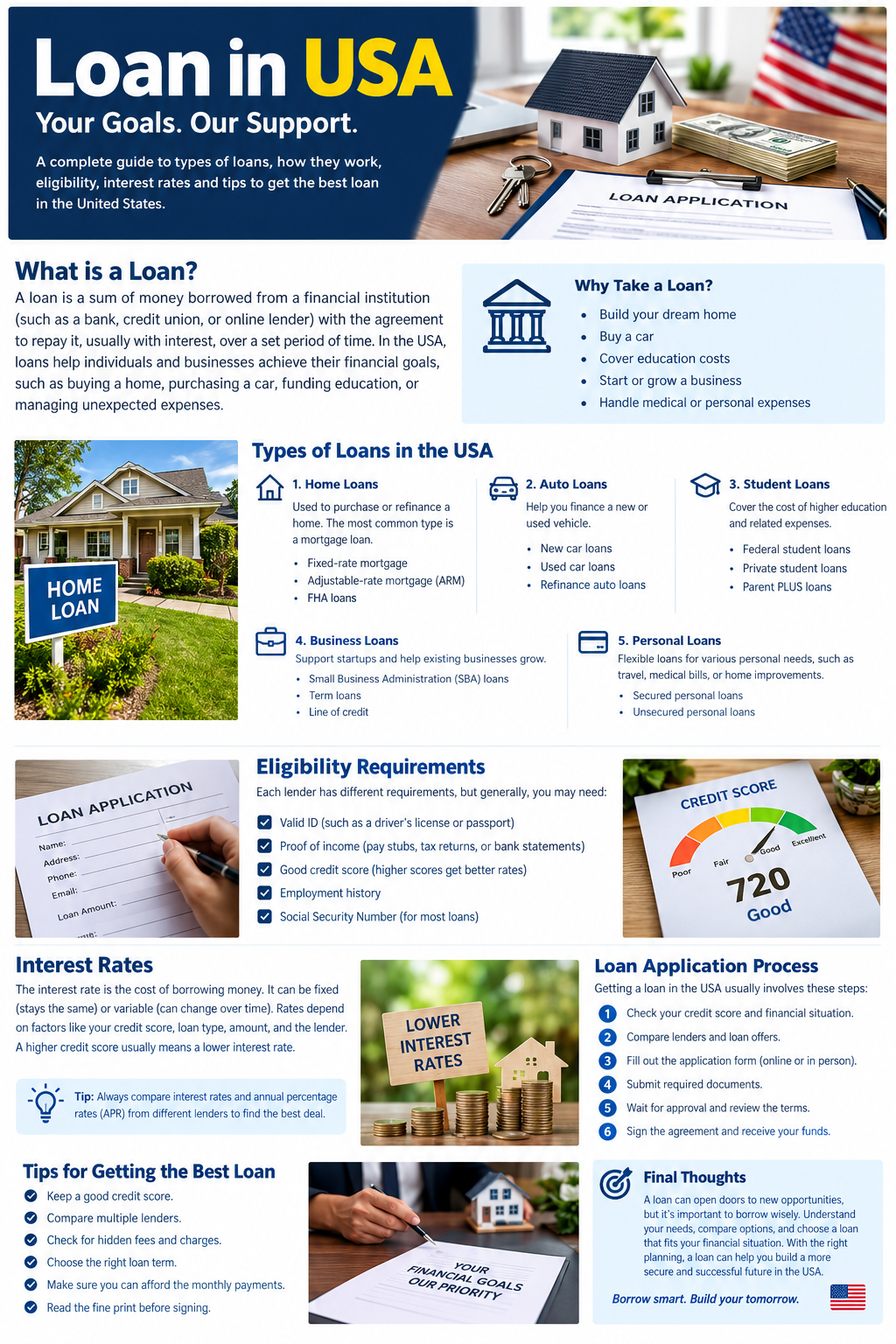
Loans in the USA: A Complete Guide to Types, Requirements, Interest Rates, and Applications
Loans are an important part of the U.S. financial system. People use loans to purchase homes and vehicles, pay for education, cover major expenses, consolidate debt, or finance a business. Businesses also use borrowing to purchase equipment, manage cash flow, expand operations, and invest in growth.
However, taking out a loan is a financial commitment. Before borrowing money, it is important to understand the interest rate, fees, repayment period, monthly payment, and other terms of the agreement.

What Is a Loan?
A loan is money borrowed from a lender with an agreement to repay the borrowed amount, generally with interest, over a specified period.
The original amount borrowed is called the principal. The lender generally charges interest for providing the funds. Depending on the loan, there may also be fees or other costs.
For example, if someone borrows $20,000 for a vehicle, the borrower generally makes scheduled payments until the principal, interest, and applicable charges have been paid according to the loan agreement.
Why Do People Take Loans in the USA?
People and businesses borrow money for many different reasons. Common purposes include:
- Buying a home
- Purchasing a vehicle
- Paying for college or professional education
- Starting or expanding a business
- Making home improvements
- Consolidating certain debts
- Paying for large planned expenses
- Managing certain unexpected expenses
The appropriate type of loan depends on the purpose of borrowing and the borrower’s financial circumstances.
Major Types of Loans in the USA
1. Mortgage and Home Loans
A mortgage is a loan used to purchase real estate. It is typically secured by the property, meaning the lender has an interest in the property as collateral for the loan.
Common mortgage structures include:
- Fixed-rate mortgages
- Adjustable-rate mortgages
- Government-backed mortgage programs
- Conventional mortgages
- Refinancing loans
Mortgage terms can vary significantly. Borrowers should compare interest rates, loan terms, closing costs, monthly payments, and other expenses before choosing a mortgage.
2. Auto Loans
Auto loans help consumers finance the purchase of new or used vehicles.
The vehicle commonly serves as collateral for the loan. If the borrower fails to meet the repayment requirements, the lender may have rights relating to the vehicle under the loan agreement and applicable law.
When comparing auto loans, consider:
- Loan amount
- Down payment
- Annual percentage rate (APR)
- Loan term
- Monthly payment
- Total amount paid
- Fees
A longer loan term can reduce the required monthly payment but may increase the total interest paid over the life of the loan.
3. Personal Loans
Personal loans are commonly used for a variety of personal expenses. Depending on the lender and product, they may be secured or unsecured.
Possible uses include:
- Home improvements
- Major purchases
- Debt consolidation
- Certain medical expenses
- Moving expenses
- Other personal needs
An unsecured personal loan generally does not require specific collateral, but approval and pricing can depend on factors such as credit history, income, debt obligations, and the lender’s underwriting criteria.
4. Student Loans
Student loans help eligible borrowers pay for higher education and related expenses.
In the USA, student borrowing can include federal student loans and private student loans. Federal student loans are offered under federal programs, while private student loans are provided by private financial institutions.
Students should carefully compare:
- Interest rates
- Fixed or variable rates
- Repayment options
- Fees
- Eligibility requirements
- Deferment or forbearance options
- Available protections
Federal and private student loans can have significantly different terms, so borrowers should understand the specific loan before accepting it.
5. Business Loans
Businesses may use loans to fund equipment purchases, inventory, expansion, working capital, or other business expenses.
Common forms of business financing include:
- Term loans
- Business lines of credit
- Equipment financing
- Commercial real estate loans
- Government-supported small-business financing
Business lenders may evaluate revenue, cash flow, credit history, time in business, collateral, and the purpose of the loan.
6. Debt-Consolidation Loans
A debt-consolidation loan can be used to combine certain existing debts into a new loan.
The objective may be to simplify repayment or potentially obtain different loan terms. However, consolidation does not automatically reduce the amount owed.
Borrowers should compare the new loan’s APR, fees, repayment period, and total cost against their existing debts.
How Interest Rates Work
Interest is one of the most important costs associated with borrowing.
A loan may have a fixed interest rate, which generally remains unchanged during the applicable period, or a variable interest rate, which can change according to the terms of the loan.
Borrowers should pay attention to the annual percentage rate (APR) because it can provide a broader measure of borrowing cost than the interest rate alone when applicable.
A lower rate does not necessarily mean a loan has a lower overall cost. Fees, repayment length, and other terms also matter.
What Determines Your Loan Interest Rate?
Lenders typically consider various factors when deciding whether to approve a loan and what terms to offer.
These can include:
- Credit history
- Credit score
- Income
- Employment history
- Existing debts
- Loan amount
- Loan term
- Down payment
- Collateral
- Type of loan
A strong credit profile can improve the terms available to some borrowers, but requirements differ between lenders and loan products.
Loan Eligibility Requirements
There is no universal eligibility requirement for every loan in the USA. Each lender establishes its own underwriting criteria.
Depending on the loan, applicants may be asked to provide:
- Government-issued identification
- Social Security number or other identifying information
- Proof of income
- Employment information
- Bank statements
- Tax documents
- Information about existing debts
- Credit history
- Information about assets or collateral
For larger loans, lenders may request additional documentation.
The Loan Application Process
Although the process varies, applying for a loan generally involves several steps.
Step 1: Review Your Financial Situation
Before applying, calculate your income, expenses, existing debt, and the amount you can reasonably afford to repay.
Step 2: Check Your Credit
Review your credit reports and credit score information where available. Correcting inaccurate information before applying may be useful.
Step 3: Determine How Much You Need
Avoid borrowing more than necessary. Estimate the amount required and consider the resulting monthly payment and total borrowing cost.
Step 4: Compare Lenders
Compare offers from banks, credit unions, online lenders, and other appropriate providers.
Look beyond the advertised interest rate and examine the APR, fees, loan term, repayment requirements, and other conditions.
Step 5: Submit an Application
The lender may request financial and personal information as part of its application and underwriting process.
Step 6: Review the Loan Agreement
If approved, carefully review the agreement before accepting it. Pay attention to the interest rate, APR, payment schedule, fees, penalties, collateral requirements, and total repayment amount.
Step 7: Receive the Funds
After the loan is finalized, the lender generally provides the funds according to the agreement.
Step 8: Make Payments on Time
Regular, on-time payments are important for maintaining the account in good standing and may also affect your credit history.
Secured vs. Unsecured Loans
One important distinction is whether a loan is secured or unsecured.
Secured Loans
A secured loan is backed by collateral. Examples can include mortgages and many auto loans.
Because collateral is involved, the lender may have rights to the collateral if the borrower fails to meet the agreement’s requirements.
Unsecured Loans
An unsecured loan does not generally require a specific asset as collateral. Personal loans and some other forms of credit may be unsecured.
Because the lender does not have specific collateral securing the loan, eligibility and pricing can depend heavily on the borrower’s creditworthiness and other financial information.
How to Choose a Loan
Before accepting a loan, compare several important factors.
Interest Rate and APR
Compare the cost of borrowing rather than focusing only on the advertised rate.
Loan Term
A longer repayment period can result in lower monthly payments, but it may increase total interest costs.
Monthly Payment
Make sure the payment fits realistically within your budget.
Fees
Check for origination fees, application fees, late-payment fees, prepayment terms, and other charges.
Total Cost
Consider how much you will pay over the entire life of the loan, not just the monthly payment.
Tips for Borrowing Responsibly
Borrowing money can be useful, but it should be approached carefully.
1. Compare multiple offers.
Different lenders can offer different rates and terms.
2. Understand the APR.
Use APR and other disclosed costs to compare applicable loan offers.
3. Borrow only what you need.
A larger loan generally means a larger financial obligation.
4. Consider the repayment period.
Understand how the term affects both your monthly payment and total cost.
5. Read the agreement carefully.
Do not accept a loan without understanding its important conditions.
6. Watch for scams.
Be cautious of lenders that guarantee approval, demand unusual upfront payments, or pressure you to provide sensitive information immediately.
7. Make payments on time.
Late or missed payments can have financial consequences and may affect your credit history.
Final Thoughts
Loans can help Americans finance major purchases, education, homes, vehicles, business activities, and other expenses. At the same time, every loan creates a repayment obligation.
Before borrowing, understand the interest rate, APR, fees, monthly payment, repayment term, collateral requirements, and total cost. Comparing multiple options and choosing a loan that fits your financial situation can help you manage borrowing responsibly.
The most important principle is simple: understand the loan before you sign the agreement.
Image: The infographic above can be used as the main/featured image for the article.